
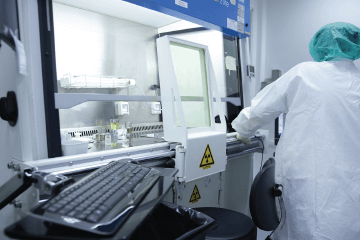
Scientific instruments and industrial systems work together remarkably well. They complement each other perfectly, because without one or the other, work cannot be as efficient as it should be. In this article, we’ll look at examples of scientific instruments (or simply, lab equipment) and industrial systems that deliver great results when used together, so you can clearly see how the two work hand in hand.
Lab Equipment vs. Large-Scale Industrial Systems
There are many kinds of lab equipment for many different uses, but in large-scale industrial systems, one instrument we often see is the radiation detector. Before we look at radiation detectors in large-scale industrial systems, let’s first understand what radiation is, what types there are, and how it affects us.
Understanding Radiation
Radiation is energy emitted from one source to another, which may be able to pass through various objects as it travels through the atmosphere. Radiation is divided into two types:
- Non-ionizing radiation: This is low-energy radiation at the lower end of the electromagnetic spectrum, such as sunlight, infrared light, microwaves, and radio waves.
- Ionizing radiation: This comes from unstable atoms or elements, known as radioactive elements, such as uranium and thorium, which are used as fuel for nuclear reactions. These unstable atoms have excess energy or mass, so to become stable, they must release this excess as radiation. The continuous, spontaneous emission of radiation by radioactive elements is called radioactivity. The ionizing radiation commonly released by unstable atoms or elements includes the following types:
- Alpha radiation
- Beta radiation
- Gamma radiation and X-rays
Health Effects of Radiation
The health effects of radiation can be divided into two types:
- Effects of low-level, long-term exposure to radiation (stochastic health effects): Although there may be health effects, it is impossible to say what the symptoms will be or how severe. However, it is generally accepted that cancer is one effect of long-term radiation exposure, and it has also been found to cause genetic changes.
- Effects of high-level, short-term exposure to radiation (non-stochastic health effects), which usually appear as acute symptoms.
Now that we have a basic understanding of radiation, let’s get to the point: the radiation detectors we often see in large-scale industrial systems. What are they, and how do they work? Scroll down to find out.
Radiation Detectors in Large-Scale Industrial Systems
Radiation detectors, or X-ray fluorescence elemental analyzers based on X-Ray Fluorescence (XRF) Spectrometry, work by combining wavelength dispersive X-ray fluorescence and energy dispersive X-ray fluorescence measurement techniques in a single instrument. They can perform highly accurate qualitative and quantitative analysis at the parts-per-million (ppm) level and above, using a computer to process data and control the instrument. They can be used in geology, mineral resources, agricultural materials, and environmental engineering.
The radiation detectors most commonly used in large-scale industrial systems are personal radiation dosimeters. These are worn on the body by people whose work involves radiation. A personal radiation dosimeter consists of radiation film and a film holder. Inside the holder are filters made of different metals, which help assess different radiation doses and radiation energies.
If you’re looking for instruments for industrial systems, you can call to ask for product details and talk directly with us at https://pico.co.th/ , and PICO’s team of experts will recommend the products best suited to your organization, business size, or factory for maximum efficiency. Importantly, PICO also focuses on long-term after-sales service under contract, taking care of products and designing complete end-to-end solutions for every type of customer factory.
Posted: Tuesday, April 21, 2020