

What Is Gas Chromatography? What to Understand Before You Buy
To research the components of a sample, we use chromatography, a technique for separating the components of a substance so they can be analyzed both quantitatively and qualitatively. It has been developed into several forms for different applications, one of which is gas chromatography, a technique that separates the components of a sample by vaporizing it.
Today, gas chromatographs are made for many purposes, including education, research, and industry. Many people may still wonder what the benefits of gas chromatography are or how it works. Here, we cover what you need to know about gas chromatographs so you can use them effectively.
Table of Contents
- What Is Gas Chromatography (GC)?
- How Gas Chromatography Works
- What Are the Benefits of Gas Chromatography?
- What Does a Gas Chromatograph Consist Of?
- Examples of Gas Chromatographs in Use
- Industrial Applications of Gas Chromatography
- Frequently Asked Questions About Gas Chromatography
- Summary: What Is Gas Chromatography?
What Is Gas Chromatography (GC)?
Gas chromatography is a technique that separates a sample by vaporizing it into a gas or vapor, so the composition and quantity of each substance in the sample can be examined and analyzed. It is commonly used to analyze volatile substances, natural gas, narcotics, and more, with high accuracy both quantitatively and qualitatively. A popular technique is Gas Chromatography Mass Spectrometry (GC-MS).
How Gas Chromatography Works
Now that you know what gas chromatography is, let’s look at how it works, so you can use the instrument correctly and obtain accurate analysis results:
- A carrier gas flows through the gas chromatography system at all times.
- The sample to be analyzed is introduced through the injector, which is a closed system to prevent gas leaks.
- The injector temperature is raised so the sample vaporizes into a gas or vapor and travels to the column together with the carrier gas.
- In the column, the components of the substance are separated.
- Once separated, the components travel from the column to the detector.
- The detector sends the measured signals to be interpreted by an electronic or computer system, and then to the data system, where the results are recorded.
Note
After passing through the detector, the substances are vented from the instrument together with the carrier gas.
What Are the Benefits of Gas Chromatography?
Gas chromatographs have a wide range of uses in education, research, and industry, including:
- Gas chromatographs can measure the components of substances in the vapor phase.
- They help you better understand the properties of a sample.
- They can determine the composition of a sample quickly.
- They can monitor a wide range of substances in the air, such as hydrogen, methane, and alcohol.
What Does a Gas Chromatograph Consist Of?
A gas chromatograph is an instrument used to examine the composition of samples. It consists of the following parts:
Injector (Inlets)
The injector introduces the sample into the column, using heat to vaporize it. Different injectors are used for different types of samples, for example:
- Gas or vapor samples: gas sampling valve
- Liquid samples: micro syringe
The heat used to vaporize the sample must be at the right level to keep the substance in the vapor phase.
Column
The column is where the sample is separated. There are two types: packed columns and capillary columns. Each type has different properties that affect how volatile substances are separated, so you should study the column types carefully before use and choose the column best suited to the sample you want to analyze.
Detectors
The detector measures the sample components separated by the column. An electronic or computer system then helps identify the type of substance being tested for further analysis. Because each type of sample has different properties, you should choose a detector suited to the sample to obtain accurate results.
Data System
The data system processes the data obtained from the sample analysis, then reports and records it in detail by computer. It provides data for both qualitative and quantitative analysis.
Examples of Gas Chromatographs in Use
• Modular oven
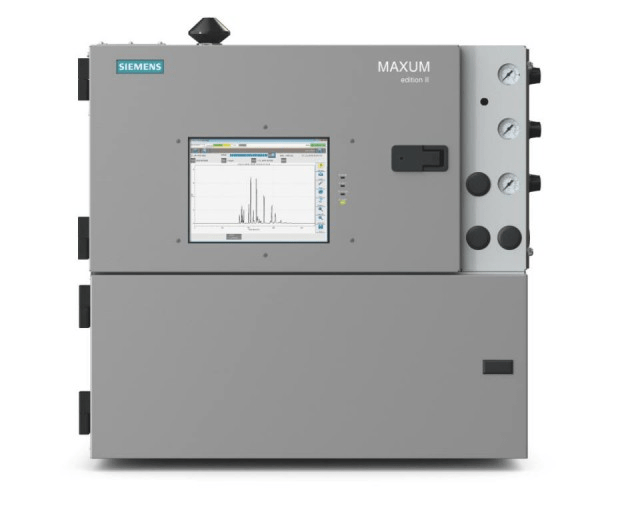
Source: https://pico.co.th/product/modular-ovenoven/
The MAXUM Modular Oven can analyze a wide variety of gases and can be fitted with up to two modular ovens, whether large or small. It is easy to use yet highly efficient, with fast detection and analysis, making it suitable for many applications.
• H2S MEDOR TRACE H2S(0-1) in Hydrogen
Source: https://pico.co.th/product/h2s-medor-trace-h2s0-1-in-hydrogen/
The H2S MEDOR TRACE H2S(0-1) in Hydrogen is a GC-ED instrument that automatically analyzes and monitors hydrogen sulfide (H2S) mixed in natural gas or fuels. It can be controlled remotely, is highly durable for long-term use, reduces gas consumption, and can store data for up to 10 years.
If you’re interested in buying a gas chromatograph or related instruments for education, research, or industrial use, you can find more details in our Gas Chromatography catalog.
Industrial Applications of Gas Chromatography
Gas chromatographs, which separate the components of substances, are generally used in industries such as herbal products, food, beverages, and perfumes. Gas chromatography is used to analyze the amounts of different substances in these products to control their quality and ensure they are safe to use.
Frequently Asked Questions About Gas Chromatography
What Is HPLC?
When people talk about gas chromatography, HPLC often comes up too. HPLC (High-Performance Liquid Chromatography) is a technique that separates liquid samples using a solid packed into a small column. It is commonly used to separate and analyze substances such as cosmetics, foods, drugs, herbal extracts, and active pharmaceutical ingredients, quickly and with high accuracy, both quantitatively and qualitatively.
What Is GC-FID and How Does It Relate to Gas Chromatography?
GC-FID is a type of gas chromatography that uses flame ionization detection (FID) to measure substances. It is currently a very popular method because it is highly sensitive, has a wide dynamic range, and responds to a wide variety of hydrocarbons. However, it cannot detect gases that are non-flammable, or that are flammable but do not produce ions.
Summary: What Is Gas Chromatography?
Gas chromatography is a technique that separates the components of a substance by vaporizing it into a vapor or gas, allowing the analysis of substances such as natural gas, volatile compounds, narcotics, and more. The recorded data can then be used and built upon in education, research, or industry.
For organizations or industries looking for a gas chromatograph or other process analysis instruments, Petro-Instruments is a supplier of high-quality instruments that perform effectively over the long term, and we’re ready to provide detailed information and advice on choosing a gas chromatograph. Contact us for more information:
Petro-Instruments Co., Ltd. (Head Office)
Address: 7/409 Soi Vibhavadi Rangsit 36, Vibhavadi Rangsit Road, Chatuchak Subdistrict, Chatuchak District, Bangkok 10900, Thailand
Business Hours: Monday–Friday, 8:30 AM–5:30 PM (closed weekends and public holidays)
Tel: (+66)2-939-5711, (+66)2-513-2333
Email: marketing@pico.co.th
Facebook: https://www.facebook.com/Petro.Instruments/